
Sub Division Management In Adelaide
All across Australia, we are seeing a huge increase in population. With an increase in immigrants and an increase in growth in general across Australia. Particularly in Adelaide, our population has grown over the last 5 years and is forecast to keep increasing.
In Adelaide, we are seeing many interstate arrivals due to the value-for- money lifestyle still available in Adelaide compared with Sydney and Melbourne. It is for this reason that many councils have relaxed their rules on subdividing parcels of
land.
Councils, such as the city of Burnside, will allow parcels of land around 800 square metres to be split in half, provided the land frontage is at least 18 metres wide in most locations across Burnside, Kensington, Hazelwood Park and Erindale. Other
councils, such as the city of Salisbury, are allowing blocks of land to be subdivided down to 300 square metres per plot of land in locations such as Para Hills, Ingle Farm and Pooraka.
The city of Marion is also allowing smaller parcels of land to be divided in Plympton, Marion and Sturt. Mitcham council area has also seen a significant growth in subdividing due to the larger parcels of land (some in excess of 1000 square metres with wide street frontages) in locations such as Daw Park, Lower Mitcham and Kingswood.
Another area which is also seeing increased development is in Magill, Payneham and Hectorville. These locations are still very
close to public transport and the city, and make great buying even when a plot of land has been subdivided.
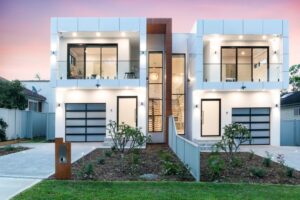
But there are some other important contributing factors that will need to be considered during the planning and approval processes of subdividing land in South Australia. In some circumstances, it is a good idea to employ the services of a Town Planner, such as Master Plan in Adelaide, who can help navigate the complexities of some sites and ensure a smooth planning and building approval journey.
- Drive way access: Can 2 driveways be achieved
- Significant trees: will this affect the development
- Infrastructure: power, water, sewer and storm water
- Contour of the land: retaining
- Easements:
- Boundary surveys: identify correct boundaries and fences
- Overlooking: privacy from neighbours, opaque glass up to 1.5m
- Land size: street appeal and frontage sizes
- Detached or attached dwellings:
- Portion of green space VS living and off-street car parking.
What is the ideal block of land to subdivide?
A clean slate is the best, one that has no easements at all on it. However, that is not always achievable, and we must deal
with this when the occasion arises.
What are some typical easements we encounter when subdividing a block of land?
A common type of easement that we work with in Adelaide is one that infrastructure owners establish to provide power, water, gas, sewer, and stormwater services to every home or building.
When an easement is on a property, this is highlighted as an exclusion zone and will have distances marked where no permanent structure can be erected. SA Water, APA and SAPN are the 3 main owners of these easements across Adelaide, and they may at some stage of the life of that service need to upgrade it or work on the equipment, hence the exclusion zones from permanent structures.
In some properties, the SA Water main sewer line runs along the back fence of houses, and this is where the sewer drains from each dwelling connects. If the sewer easement blocks up, SA Water will need to access it and then hydro jet clean the pipes to most likely remove tree roots, etc.
Rights Of Way
Another type of easement is called rights of way. This type of easement is put in place to once again allow access to a property where there may be items such as overhead power lines, and a clear access path must always be kept clear of permanent structures to allow access through to this piece of infrastructure.
Heritage-listed land will also have rights of way placed upon it to make sure no one can ever build on this land because it is protected for heritage reasons. Local councils can also have stormwater easements that may run through properties. These types of easements are commonly found in older suburbs of Adelaide, such as Unley, Highgate, Maylands and Norwood. The older large parcels of land that have since been split up into smaller parcels in the early 1900s had stormwater pipes in them and were not discovered until many years later, and have been left in operation.
Probably something which is not correctly called an easement but needs to be treated almost like one is significant trees. A significant tree will have a TPZ placed upon it. The TPZ Tree Protection Zone is an exclusion zone where no excavation can be performed, and therefore, limiting the building footprint as to create a building we will normally need some kind of excavation to stabilise the building.
When an easement is identified, we need to carefully design the homes that will now be built on these plots of dirt. The key is to still maximise that overall development to gain as much building footprint while still maintaining an economical building development.