
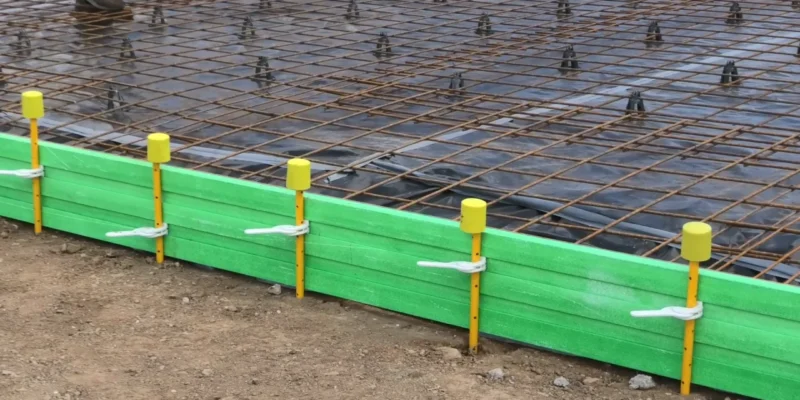
Remove vertical formwork from slabs after 16 to 24 hours. The slab’s horizontal support forms must stay longer. Concrete should reach 70% of its design strength before their removal. This process often takes 7 to 21 days. The total slab span determines the final required time for safe removal.
Fundamental Principles: When Should Formwork Be Removed?
The decision of when to remove formwork, or “strike” it, from a concrete slab is an important engineering judgment that directly impacts structural integrity, safety, and project timelines. Premature removal can lead to excessive deflection, surface defects, or catastrophic failure. Conversely, leaving formwork in place for too long can delay subsequent construction activities and increase costs. The determination hinges on a core principle: the concrete must have achieved sufficient strength to support its own weight (dead load) and any construction loads that will be applied to it without adverse effects. This process is governed by the rate of concrete strength gain, the type of formwork used, and the ambient environmental conditions.
The Critical Role of Concrete Strength Gain
Concrete does not “dry” but cures through a chemical reaction called hydration, where water reacts with cementitious materials to form a crystalline matrix that binds the aggregates. This process is what gives concrete its compressive strength. The rate of strength gain is logarithmic, meaning it is rapid in the first few days and slows over time. A typical concrete mix may achieve:
- 40-50% of its 28-day design strength in 3 days.
- 65-75% of its 28-day design strength in 7 days.
- 85-95% of its 28-day design strength in 14 days.
- ~99% of its 28-day design strength in 28 days.
The fundamental requirement for striking formwork is that the in-place concrete strength must be high enough to resist the stresses imposed upon it. These stresses primarily come from the slab’s self-weight and any additional construction loads, such as materials, equipment, or workers. The required strength is specified by the structural engineer and is typically a percentage of the concrete’s characteristic 28-day design strength (f’c).

Differentiating Between Vertical and Horizontal Formwork
Understanding the function of different formwork components is essential to determining the appropriate removal time. Formwork can be broadly categorized into two types, each with distinct requirements for striking.
- Vertical Formwork: This includes the forms for columns, walls, and the sides of beams. This type of formwork is not load-bearing once the concrete has set. Its primary purpose is to contain the wet concrete and shape the element. As it does not support any vertical loads, it can be removed much earlier than horizontal formwork. The main consideration for its removal is ensuring the concrete surface is hard enough to resist damage during the stripping process and to hold its own shape.
- Horizontal Formwork: This includes the soffit forms (the underside sheathing) and the shoring (props and supports) for slabs and beams. This formwork is critical as it supports the full weight of the concrete until it has gained enough strength to be self-supporting. The removal of this load-bearing system is the most critical step and must be guided by strict strength and time requirements.
Impact of Environmental Conditions on Curing Time
The rate of hydration is highly sensitive to temperature and moisture. These environmental factors significantly influence how quickly concrete gains strength and, consequently, when formwork can be removed.
- Temperature: Higher ambient temperatures accelerate the hydration reaction, leading to faster strength gain. In warm weather (e.g., above 25°C or 77°F), stripping times may be reduced. Conversely, cold temperatures (below 10°C or 50°F) drastically slow hydration. In such conditions, formwork must be left in place much longer, and cold-weather protection measures like insulating blankets or heated enclosures may be necessary to ensure proper curing.
- Moisture: Hydration requires the presence of water. If the concrete surface is allowed to dry out prematurely, the curing process will stop, and the concrete will not achieve its full potential strength. Therefore, proper curing techniques (e.g., wet curing, curing compounds) are vital. This ensures the concrete in place achieves the required strength within the expected timeframe.
- Wind: High winds can increase the rate of evaporation from the concrete surface, leading to premature drying and potential plastic shrinkage cracking. This can compromise the surface integrity and affect overall strength development.
Prescribed Concrete Formwork Striking Times
While the ultimate determinant for formwork removal is concrete strength, industry standards and codes of practice provide time-based guidelines. These schedules are typically conservative and assume standard conditions (e.g., Ordinary Cement, temperatures above 15°C). They serve as a reliable baseline but should always be used in conjunction with engineering judgment and, where possible, strength verification testing.
Time-Based Guidelines vs. Strength-Based Verification
There are two primary methods for deciding when to strip formwork. Each way has its own set of advantages and applications.
- Time-Based Method: This traditional approach relies on minimum time periods specified in building codes like AS 3600. These periods are based on decades of empirical data and provide a safe, if not always efficient, schedule. They are simple to follow but do not account for variations caused by special cement types, admixtures, or actual job-site weather conditions.
- Strength-Based Method: This modern approach allows formwork removal once the in-place concrete has reached a pre-determined percentage of its design strength, as verified by testing. This is a more precise and efficient way, as it can significantly shorten formwork cycle times in favorable conditions, leading to faster project completion. It requires a robust quality control program with on-site testing of concrete samples.
Detailed Striking Time Table for Concrete Elements
The following table provides a comprehensive guide on when to remove formwork from a concrete slab and other elements, outlining the necessary concrete strength to support subsequent loads and protect the finished surface. The proper way to strip formwork is dependent on the type of cement, ambient temperature, and the specific element in place.
A guide on when to remove formwork from a concrete slab, considering the necessary concrete strength to support subsequent loads and protect the finished surface. The proper way to strip formwork is dependent on the type of cement, ambient temperature, and the specific element in place.
| Formwork Component | Minimum Period (Ordinary Portland Cement, Temp >15°C) | Required Concrete Strength (% of Design) | Key Considerations & Impact of Loads |
|---|---|---|---|
| Vertical Formwork (Columns, Walls, Beam Sides) | 16 – 24 Hours | ~15-20% | This formwork is non-load-bearing; early removal is possible but care must be taken to not damage the concrete surface or edges. |
| Slab Soffits (Props can be re-fixed immediately after removal) | 3 Days | ~40% | Allows for reuse of sheathing while reshoring supports the slab against its own dead loads until it gains sufficient strength. |
| Slab Soffits (Props completely removed) | Span up to 4.5m: 7 Days | ~70-75% | The concrete must have enough strength to support its self-weight and any imposed construction loads without excessive deflection. |
| Slab Soffits (Props completely removed) | Span over 4.5m: 14 Days | ~70-75% | Longer spans impose higher dead loads on the slab, requiring a longer curing time for the concrete to gain adequate strength. |
| Beam Soffits (Props can be re-fixed immediately after removal) | 7 Days | ~50% | Similar to slabs, this way allows for faster formwork cycling while ensuring the beam is supported against initial self-weight loads. |
| Beam Soffits (Props completely removed) | Span up to 6m: 14 Days | ~80-85% | Beams are critical structural elements; their formwork must remain in place longer to prevent failure under self-weight. |
| Beam Soffits (Props completely removed) | Span over 6m: 21 Days | ~80-85% | Significant spans carry heavy loads and demand a high percentage of design strength before full support is removed. |
| General Strength-Based Removal | Varies (Test Dependent) | 70% of characteristic strength | A modern way to determine stripping time; removal is permitted once on-site cube/cylinder tests confirm the concrete in place has reached this target. |
Sources: Based on guidelines from IS 456:2000 (Indian Standard Code of Practice for Plain and Reinforced Concrete) and principles from ACI 318 (American Concrete Institute).
Vertical Formwork (Non-Load-Bearing)
For vertical components, the primary concern is marring the concrete surface. The removal window of 16-24 hours allows the concrete to be hard enough to be self-supporting and resistant to minor damage, but still “green” enough for minor surface repairs or finishing if needed.
Horizontal Formwork (Soffits and Beams)
The support system for slabs and beams is critical. The concept of reshoring is often employed on multi-story projects to accelerate construction. In this process, the main shoring and sheathing are removed after a few days (e.g., 3 days), and a smaller number of props (reshores) are immediately re-installed to continue supporting the slab. This frees up the bulk of the formwork material for use on the next level while ensuring the slab receives the support it needs to handle its own weight and further construction loads.
The Influence of Span Length on Removal Times
The dead load of a slab or beam increases significantly with its span. Longer spans result in higher bending moments and shear stresses at the center and supports. Consequently, the concrete must achieve a higher level of strength before the formwork can be safely removed. This is why codes and standards prescribe longer minimum periods for longer spans, ensuring the structural element can carry these higher internal loads without risk of failure or excessive long-term deflection.
Technical Procedure: A Step-by-Step Guide to Removing Formwork
The physical act of removing formwork must be done systematically and carefully to prevent damage to the structure and ensure the safety of workers.
Pre-Removal Inspection and Safety Protocol
Before any stripping work begins, a thorough inspection and safety review are mandatory. This protocol is the correct way to initiate the process.
- Confirm that the engineer of record has approved formwork removal.
- Verify that the concrete has achieved the specified minimum strength.
- Ensure the area below the formwork is properly cordoned off and clear.
- Inspect all formwork components for any signs of binding or stress.
- Wear appropriate Personal Protective Equipment (PPE), including hard hats and gloves.
- Have a clear plan for lowering and handling heavy formwork panels.
- Check that all temporary loads have been removed from the slab surface.
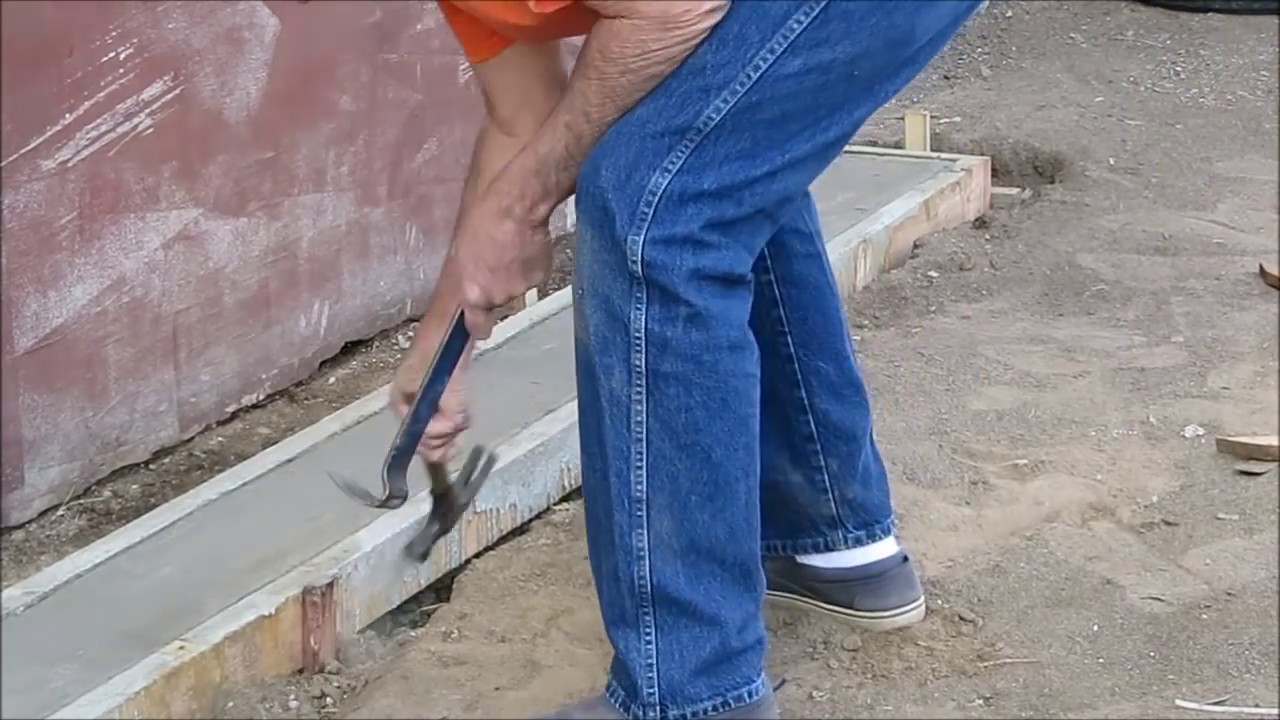
Verifying Concrete Strength In-Place
The most reliable method for strength verification is testing samples cured under the same conditions as the actual structure. Field-cured cylinders or cubes are cast from the same concrete batch used in the slab and are left to cure alongside it. These samples are then tested in a compression machine at various intervals (e.g., 3, 7, 14 days) to directly measure the in-place compressive strength. This data provides definitive proof that the concrete has reached the required strength for safe stripping.
Sequential Removal Process for Slabs and Beams
The removal process should be sequential and deliberate to avoid shock loading the new concrete structure. A disorganized removal can create unintended stress points.
- Ease Connections: Begin by gently loosening wedges, clips, and ties. Do not remove them completely at first. This allows the formwork to slightly separate from the concrete surface without a sudden drop.
- Remove Vertical Forms: Start by stripping the vertical formwork, such as beam sides and column forms, as they are non-load-bearing.
- Lower Horizontal Supports: For horizontal formwork, systematically lower the shoring props. This should be done gradually, working from the mid-span outwards towards the supports. Never remove all props from one area at once.
- Remove Sheathing: Once the supports are lowered, the soffit sheathing (plywood or panels) can be carefully pried away and removed. Avoid using the concrete as a leverage point, as this can chip or damage the surface.
Post-Removal Surface Inspection and Curing
Immediately after the formwork is removed, the concrete surface should be inspected for any defects such as honeycombing, voids, or rock pockets. Minor imperfections can be repaired with an appropriate grout mixture. Most importantly, the curing process must continue. The formwork provides a barrier against moisture loss, and its removal exposes the concrete to the air. It is critical to apply a curing compound or use other methods like wet burlap to ensure the slab continues to hydrate and achieve its full design strength.
Preliminary Considerations: Concrete Placement and Mix Design
The timeline for formwork removal is heavily influenced by decisions made before the concrete is even poured. Proper planning of the concrete mix and placement procedures is essential.
How Concrete Mix Affects Formwork Removal Time
The composition of the concrete mix has a direct impact on its rate of strength gain. Engineers can manipulate the mix design to accelerate the construction schedule.
- Cement Type: Using Type III (High-Early-Strength) cement can significantly reduce the time needed to reach the required strength for stripping.
- Admixtures: Chemical admixtures like accelerators can be added to speed up hydration, especially in colder weather. Water-reducing admixtures can increase strength without adding more cement.
- Water-Cement Ratio: A lower water-to-cement ratio results in a higher-strength, more durable concrete that gains strength more quickly.
Best Practices for Pouring a Concrete Slab
The quality of the concrete placement is just as important as the mix design. A well-executed pour ensures a homogenous, strong slab.
- Ensure all reinforcement and embedded items are securely in place.
- Deposit the concrete as close to its final position as possible.
- Consolidate the concrete thoroughly with vibrators to remove air pockets.
- Properly level and finish the concrete surface to achieve the desired texture.
- Begin curing procedures as soon as the surface finish will not be damaged.
- Protect the fresh concrete from extreme weather conditions.
- The way concrete is placed and finished directly affects its surface quality.
The Importance of Professional Formwork Installation
The ease and safety of formwork removal begin with its construction. Professional installation is not just about containing wet concrete; it’s about designing a system that can be dismantled efficiently without damaging the structure it helped create.
Why Proper Formwork Carpentry is Crucial for Safe Removal
A well-designed formwork system is built with removal in mind. Key elements include using release agents on the form faces, ensuring components are not wedged too tightly, and designing a shoring system that can be lowered systematically. Poorly built formwork can bind to the concrete, making it extremely difficult to remove and increasing the risk of damaging the new concrete surface and edges. The strength and stability of the formwork itself are paramount to preventing blowouts during the pour and ensuring a safe environment.
Finding and Vetting a Formwork Specialist
Engaging a qualified formwork contractor is a critical investment. When sourcing a specialist, look for a team with extensive, verifiable experience on projects of a similar scale and complexity. A professional formwork carpenter understands the structural loads involved, knows how to build for efficient stripping, and can contribute to a safer and faster construction cycle. Their expertise is a crucial part of the overall strategy for successfully placing concrete and determining the right time to remove the formwork.
Commonly Asked Questions
Below you can see common questions we get asked.
What is the safest way to remove formwork without affecting the concrete’s surface strength?
The safest way is to strip formwork gently to avoid shocking the concrete. This protects the new surface and ensures it has the required strength before it bears any loads. Avoid prying against the concrete placed in the formwork.
How do future loads influence when to remove formwork from a concrete slab?
Anticipated loads dictate the required concrete strength before formwork removal. If heavy loads will be placed on the surface soon, the formwork must stay longer, ensuring the slab achieves sufficient strength to prevent deflection or structural damage.
Besides time, what is the best way to verify concrete strength before removing formwork?
The most reliable way is testing field-cured concrete cylinders. This directly measures the in-place compressive strength, confirming the slab can support its own weight and initial loads before you remove the formwork.