
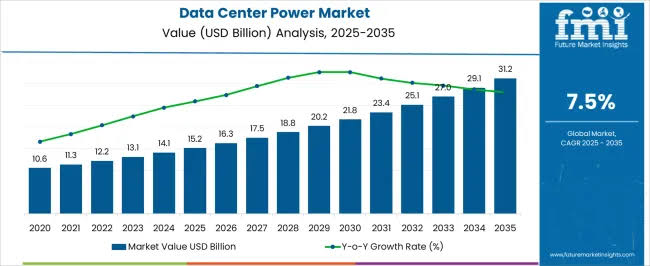
Data centres use so much electricity because they operate large numbers of servers continuously, while also powering the cooling, networking and electrical systems needed to keep those servers available. Most electricity goes to computing equipment, but removing the heat it produces adds another substantial load.
The important distinction is between how much power a data centre can draw and how much electricity it actually uses. A proposed 100-megawatt data centre does not necessarily consume 100 megawatts every hour. The figure may describe its maximum connection capacity, planned IT load or eventual capacity after several construction stages.
Understanding that difference is especially important in Australia, where data centre electricity demand is forecast to increase significantly as AI and cloud infrastructure expands.
Where does a data centre use electricity?
A data centre is more than a room full of computers. It is a building designed to run computing equipment reliably, manage the heat that equipment creates and maintain service when individual components fail.
| Equipment or system | Why it needs electricity |
|---|---|
| Servers | Process requests, operate applications and perform calculations, including AI workloads. |
| Storage | Keep information accessible and available when needed. |
| Networking | Move data between servers, storage equipment and users. |
| Cooling | Operate fans, pumps and refrigeration equipment to remove heat. |
| Electrical infrastructure | Convert and distribute power, with some energy lost during the process. |
| Building services | Operate security systems, lighting and other supporting equipment. |
According to the International Energy Agency (IEA), servers account for around 60% of electricity demand on average in modern data centres.
Cooling requirements vary considerably. The IEA estimates that cooling accounts for approximately 7% of electricity consumption in efficient hyperscale facilities, compared with more than 30% in some less efficient enterprise data centres.
These percentages describe different types of facilities. They should not be treated as a fixed breakdown for every data centre.
Why does a data centre need so much cooling?
Almost all the electricity consumed by computing equipment eventually becomes heat. That heat must be removed to keep servers operating within acceptable temperature limits.
Think of a laptop becoming warm while exporting a large video. The same principle applies to a data centre, except the heat is generated by entire rows of equipment operating continuously.
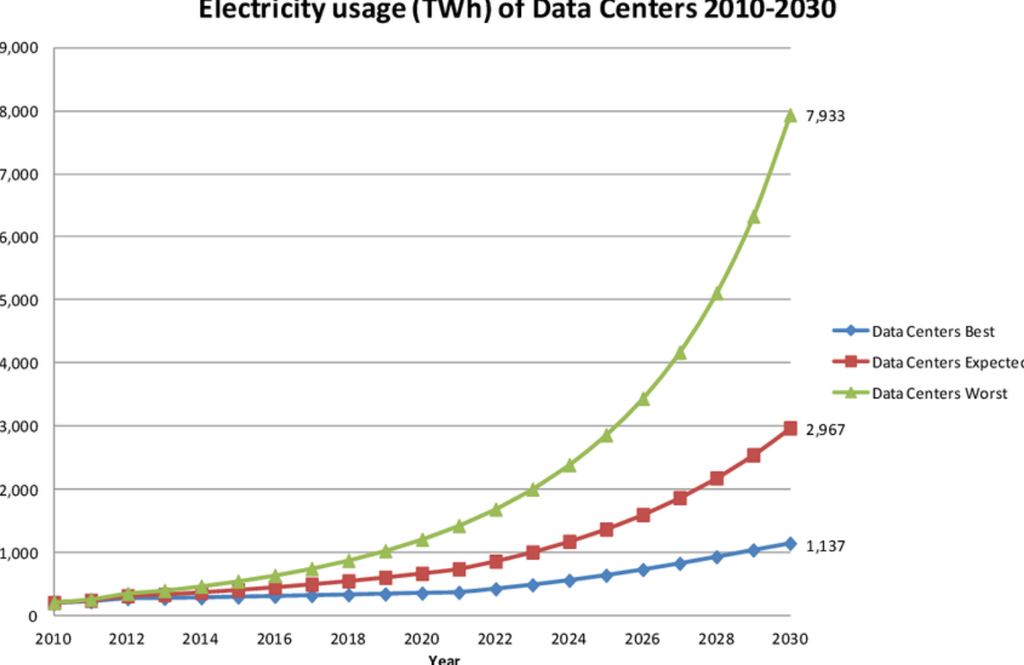
Image source: https://www.researchgate.net/figure/Estimation-of-Data-Centre-Energy-Consumption-by-2030-11_fig2_385191670
Does 1 MW of server power require another 1 MW for cooling?
No. This is a common misunderstanding.
If servers and other IT equipment consume 1 megawatt (MW), approximately 1 MW of heat must be removed from the equipment and surrounding environment under steady operating conditions.
However, removing 1 MW of heat does not necessarily require 1 MW of additional electricity.
Cooling equipment uses electricity to move heat rather than create an equivalent amount of cooling energy through electricity consumption alone.
For example, a cooling system may circulate water through equipment and release heat outdoors. When external conditions are favourable, the system may need relatively little mechanical refrigeration. During hotter conditions, compressors, pumps or fans may consume more electricity.
This helps explain why two facilities with similar computing loads can have different total electricity consumption.
Cooling requirements also depend on equipment density, airflow management, building design and local climate. For a related explanation of cooling systems, see why data centres need water.
Why do AI data centres use more power?
Artificial intelligence can increase electricity demand because some AI workloads require large numbers of specialised processors working simultaneously.
Training a large AI model may involve extensive calculations across many processors for prolonged periods. Once a model is deployed, responding to user requests also consumes computing resources.
Traditional business applications can have periods of relatively low activity. AI systems, particularly those supporting large-scale inference or training, may place sustained demands on computing infrastructure.
However, not every AI workload uses more electricity than every conventional application. Consumption depends on the hardware, workload, utilisation and efficiency.
Power density matters more than building size
One important consideration is power density: how much electricity computing equipment requires within a particular area or rack.
A rack containing high-performance AI processors may draw considerably more power than a rack of conventional servers.
Higher power density can require:
- Greater electrical distribution capacity.
- More concentrated heat removal.
- Different cooling equipment or liquid-cooling systems.
- Careful planning of equipment layout and supporting infrastructure.
This means two data centres with similar floor areas can have substantially different electricity demands.
Practical implication: Building size alone is not a reliable way to estimate data centre electricity consumption. IT capacity, equipment utilisation and cooling design are more useful starting points.
How much electricity does a 10 MW data centre use?
Before calculating annual electricity consumption, it is necessary to establish what the quoted megawatts represent.
Megawatts (MW) measure power at a particular moment. Megawatt-hours (MWh) measure electricity consumed over time.
A facility drawing an average of 10 MW continuously uses:
- 240 MWh in 24 hours.
- 7,200 MWh over a hypothetical 30-day period.
- 87,600 MWh, or 87.6 gigawatt-hours (GWh), over a 365-day year.
The annual calculation is:
10 MW × 8,760 hours = 87,600 MWh = 87.6 GWh
But that result only applies when 10 MW represents the average electricity draw over the entire year.
Three different meanings of a 10 MW data centre
| What 10 MW means | Annual electricity consumption |
|---|---|
| Average power drawn by the entire facility | 87.6 GWh |
| Average IT equipment power, with annual PUE of 1.3 | 113.88 GWh |
| Maximum grid connection capacity | Cannot be determined without actual or expected average demand |
The difference matters because project descriptions may refer to different boundaries and stages of development.
A 10 MW grid connection is not proof that a facility currently consumes 10 MW. It tells us the capacity of the connection, not the average amount of power drawn from it.
What is power usage effectiveness (PUE)?
Power usage effectiveness (PUE) measures the relationship between the total energy used by a data centre and the energy consumed by its IT equipment over the same period.
The formula is:
PUE = Total facility energy ÷ IT equipment energy
For example, a PUE of 1.3 means that every 1 kilowatt-hour (kWh) consumed by IT equipment corresponds to 1.3 kWh consumed by the whole facility.
The additional 0.3 kWh covers supporting systems such as cooling, power distribution losses and building services.
Consider a facility averaging 10 MW of IT electricity demand throughout the year:
- Annual IT electricity consumption: 87.6 GWh.
- Assumed annual PUE: 1.3.
- Annual whole-facility electricity consumption: 113.88 GWh.
The result is calculated as:
87.6 GWh × 1.3 = 113.88 GWh
There is an important limitation: PUE must be applied to the correct boundary.
If a reported power figure already includes cooling and other facility systems, applying PUE again would double-count those loads.
The Australian Government’s data centre energy-efficiency guidance explains PUE and the importance of measuring electricity consumption across different facility systems.
Does a data centre use its maximum power all the time?
Not necessarily. A data centre can operate around the clock without drawing its maximum electrical capacity every hour.
Electricity consumption changes for several reasons:
- Computing workloads increase or decrease.
- Servers may operate below their maximum processing capacity.
- New equipment may be installed in stages.
- Customer demand may take years to reach mature levels.
- Cooling electricity demand changes with external conditions.
Even when activity is relatively low, servers, storage and network equipment may still need to remain available.
Worked example: Connection capacity versus actual demand
Consider a hypothetical data centre with a maximum whole-site grid connection capacity of 20 MW.
If its average electricity draw is 30% of that capacity over a year, its average demand would be 6 MW.
6 MW × 8,760 hours = 52.56 GWh annually
If the average draw subsequently increases to 60% of connection capacity, average demand becomes 12 MW.
12 MW × 8,760 hours = 105.12 GWh annually
| Scenario | Average site demand | Annual electricity use |
|---|---|---|
| 30% average use of connection capacity | 6 MW | 52.56 GWh |
| 60% average use of connection capacity | 12 MW | 105.12 GWh |
| 100% average use of connection capacity | 20 MW | 175.2 GWh |
These are illustrative mathematical scenarios, not reported utilisation rates for an actual data centre. The percentages describe average whole-site draw relative to connection capacity, not CPU or server utilisation.
The example demonstrates why a facility’s electricity consumption can double without any change to its grid connection rating or building footprint.
For Australian communities evaluating developments, this is an important distinction. A building can look unchanged from the outside while its internal equipment and electricity demand increase substantially.
How much electricity do Australian data centres consume?
Oxford Economics Australia and the Australian Energy Market Operator (AEMO) published their Data Centres Energy Demand Outlook in Australia on 25 August 2026.
Under the central Step Change scenario, the report estimates and forecasts national data centre electricity consumption as follows:
| Financial year | National data centre electricity consumption |
|---|---|
| 2025–26 | 5.2 TWh |
| 2029–30 | 15.8 TWh |
| 2035–36 | 34.3 TWh |
The 2025–26 figure is an estimate; the later figures are projections, not guaranteed future electricity consumption.
The same report provides slightly lower figures for the National Electricity Market (NEM), which should not be confused with the national totals.
What is driving the projected increase?
An important finding is that new buildings are not the only source of growth.
Oxford Economics and AEMO identify the ramp-up of existing data centres and expansions of existing facilities as major drivers of near-term electricity demand.
Over time, newly developed facilities are expected to become increasingly important.
This means electricity forecasts cannot be understood simply by counting how many data centres are being built. The amount of equipment operating inside existing buildings also matters.
The report also highlights uncertainty about which proposed projects will proceed, when they will connect to the electricity network and how quickly they will reach mature operating loads.
Can an efficient data centre still use more electricity?
Yes. Improved efficiency does not automatically mean lower total consumption.
Consider a hypothetical facility that initially averages 5 MW of IT demand with an annual PUE of 1.4.
Its average whole-site demand is:
5 MW × 1.4 = 7 MW
Later, IT demand doubles to 10 MW, while its PUE improves to 1.2.
Its average whole-site demand becomes:
10 MW × 1.2 = 12 MW
| Measure | Initially | After expansion |
|---|---|---|
| Average IT power | 5 MW | 10 MW |
| Annual PUE | 1.4 | 1.2 |
| Average whole-site power | 7 MW | 12 MW |
| Annual whole-site electricity | 61.32 GWh | 105.12 GWh |
The facility has become more efficient at supporting each unit of IT electricity consumption, yet its overall electricity use has increased by approximately 71%.
This is why PUE alone cannot establish whether a data centre’s total electricity demand is rising or falling.
A meaningful assessment should consider both efficiency and the absolute quantity of electricity consumed.
Do backup generators contribute to normal electricity demand?
Backup generators are generally designed to supply electricity during interruptions to the normal power supply. They do not ordinarily operate continuously simply because they have a high power rating.
A generator’s rated capacity describes the power it can deliver when operating, not its contribution to everyday grid electricity consumption.
Generators may operate during testing or outages, while other equipment such as uninterruptible power supplies supports continuity during power disturbances.
Some backup arrangements therefore have electricity or fuel requirements separate from normal grid consumption.
This also matters when considering the effects of a facility on neighbouring properties. Cooling equipment may operate regularly, while standby generators generally operate intermittently. See are data centres noisy? for a related explanation.
How can you assess the electricity demand of a proposed data centre?
When reviewing a proposed Australian data centre, five questions can help distinguish a headline capacity figure from a meaningful electricity estimate.
- What does the quoted MW figure describe? Is it grid connection capacity, average facility demand, IT capacity or another measure?
- Does the figure include cooling? Confirm whether electricity for pumps, fans, refrigeration and electrical losses is already included.
- Is the figure a maximum or an expected average? Maximum capacity alone cannot establish annual electricity consumption.
- Which stage of development does it represent? The initial building may operate at a fraction of the planned completed campus capacity.
- What assumptions support the annual estimate? Look for operating hours, expected average load, utilisation assumptions and annual PUE where relevant.
If an announcement gives only maximum connection capacity, annual consumption cannot be determined reliably without additional operating assumptions.
For broader context on Australian developments, see who is building data centres in Australia?.
The bottom line
Data centres use large amounts of electricity because they bring substantial computing capacity into concentrated locations and maintain the systems required to operate it reliably.
Servers account for most of the demand in a typical modern facility, while cooling, networking, storage and electrical infrastructure add to the total.
AI can increase electricity demand by raising computing intensity and equipment power density. However, the actual electricity used by a facility depends on its workload, equipment, operating conditions and stage of development.
When assessing a data centre, the most useful question is not simply how many megawatts it is rated for, but how much electricity the entire facility is expected to consume over a given period.
Sources and calculation notes
This article draws on published research and government technical guidance. The worked examples are illustrative calculations developed to explain how electricity consumption, connection capacity and PUE relate to one another. They are not measurements of a specific facility.
- International Energy Agency: Energy and AI – Energy demand from AI (2025). Used for data centre equipment categories, typical electricity shares and AI-related energy demand.
- Oxford Economics Australia and AEMO: Data Centres Energy Demand Outlook in Australia (25 August 2026). Used for Australian consumption estimates, forecast scenarios and facility ramp-up analysis.
- Australian Government: Data centres – energy-efficiency guidance. Used for PUE, cooling performance, power infrastructure and efficiency considerations.
Calculation assumptions: A full year is taken as 365 days or 8,760 hours. Average electrical loads are assumed constant in the worked annual examples unless otherwise stated. PUE examples use assumed annual ratios, not measured values from a named facility. Electricity figures may differ from actual grid imports where on-site generation or other supply arrangements apply.
Source review date: 6 November 2026. Future electricity consumption figures are scenario forecasts and may change as demand, technology and development schedules evolve.