
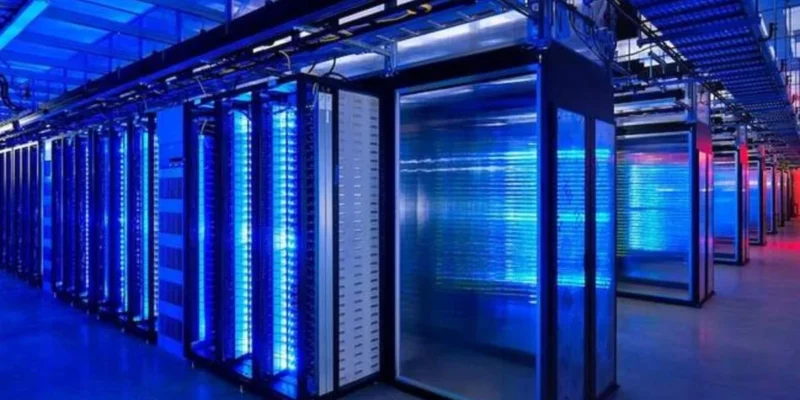
Data centres use water mainly to help remove heat from servers and other computing equipment.
Every time a server processes data, it produces heat. At the scale of a data centre, thousands of servers may be running continuously, so that heat has to be collected, moved away from the equipment and released outside the building.
Water is useful because it can carry heat efficiently. In some cooling systems, water also evaporates, and that evaporation helps remove heat from the facility. When this happens, the lost water has to be replaced.
However, not every data centre uses large amounts of water. Some systems circulate water through sealed loops. Some use air cooling, refrigeration, dry coolers or direct-to-chip liquid cooling. Some use recycled or non-potable water instead of drinking water.
The important question is not simply:
“Does the data centre use water?”
A better question is:
“How does the facility reject heat, how much replacement water does it need, and where does that water come from?”
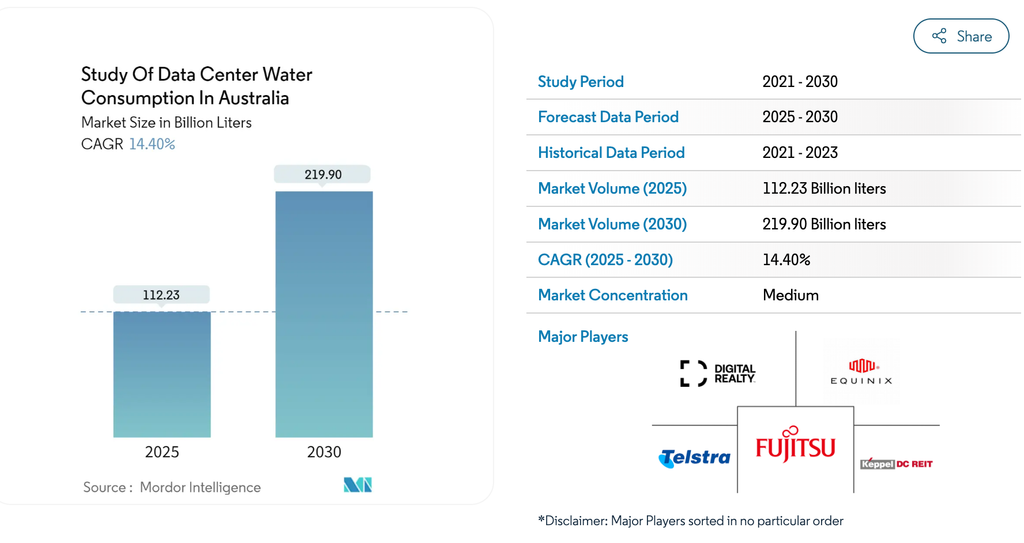
Image source: https://www.mordorintelligence.com/industry-reports/study-of-data-center-water-consumption-in-australia
Why do data centres need so much cooling?
Think about how warm a laptop can get when it is working hard. A data centre is that same basic problem at a much larger scale.
Servers, processors, memory, power supplies and networking equipment all turn electrical energy into heat. If that heat is not removed, equipment can slow down, shut down or fail.
Fans can move warm air away from the servers, but the heat still has to leave the building. Moving heat from one part of a room to another does not solve the problem.
That is why data centres rely on mechanical services such as air handling units, chilled-water systems, pumps, heat exchangers, chillers, cooling towers, refrigerant systems and liquid cooling equipment.
The exact design depends on the facility, the climate, the computing load and the operator’s priorities around energy use, water use, reliability and cost.
How water can cool a data centre
Water can play two different roles in a data centre cooling system:
- Collecting heat from equipment
- Releasing that heat outside the building
Those two jobs are not always done by the same water circuit.
In a conventional chilled-water and cooling-tower arrangement, the process may work like this:
- Air carries heat away from the servers.
- Cooling equipment transfers that heat into a chilled-water loop.
- A chiller transfers the heat into a separate condenser-water loop.
- The condenser water carries the heat to a cooling tower.
- At the cooling tower, some water evaporates and releases heat into the outside air.
That does not mean water is flowing over exposed computer equipment. The water is moving through controlled mechanical systems.
In newer high-density systems, liquid cooling may collect heat closer to the source. For example, direct-to-chip cooling uses liquid-filled cold plates attached to hot components. The liquid remains contained inside the cooling system.
Either way, the heat still has to go somewhere.
Where does the water actually go?
In many cooling-tower systems, most of the water is recirculated. But recirculation does not mean the system can run forever without a fresh supply.
Water can leave the system in several ways:
| Route | What happens |
|---|---|
| Evaporation | Some water becomes vapour and carries heat into the atmosphere. |
| Blowdown | Some water is deliberately drained to manage dissolved minerals. |
| Drift | Small droplets can escape with the airflow, although equipment is used to reduce this. |
| Leaks or overflow | Faults, poor control or ageing equipment can cause avoidable losses. |
The replacement water added to the system is called make-up water.
Evaporation leaves minerals behind. If those minerals are not managed, they can build up and contribute to scale, corrosion or poor performance. That is why cooling-tower systems need water treatment, monitoring and controlled discharge.
Water that evaporates has not disappeared from the planet. But it is no longer immediately available to the local water supply from which it was taken. That distinction matters when communities are assessing pressure on local water resources.
Does a closed-loop system still use water?
Yes, it can.
“Closed loop” means liquid circulates within a contained circuit. It does not automatically mean the whole building has no water consumption.
For example, a server cooling loop might be closed, while another part of the facility still uses a cooling tower that evaporates water outside.
So the key question is:
Does the final stage of cooling evaporate water?
If the system ultimately rejects heat through evaporation, it will need make-up water. If the system rejects heat through dry coolers, air cooling or other non-evaporative methods, ongoing on-site cooling-water demand may be much lower.
Microsoft has described newer data centre designs that use closed-loop liquid cooling and consume zero water for cooling during normal operation. That is an important design shift, especially for high-density AI workloads. But it is not the same as saying every data centre, or every Microsoft facility, uses no water.
Water may also still be needed elsewhere on site, including for amenities, cleaning, landscaping, commissioning, maintenance or fire systems.
What data centre cooling experts and operators say
Industry guidance is increasingly clear on one point: data centre water use has to be assessed locally.
Uptime Institute, a well-known data centre authority, has warned that general statements about data centre water use can be misleading because the impact depends on the local water supply, the climate, the cooling system and competing demands in the watershed. In water-stressed areas, Uptime Institute says operators should consider dry cooling or minimal-water cooling strategies.
ASHRAE’s data centre guidance also shows that cooling design is not one-size-fits-all. Its technical work covers environmental limits for air-cooled and liquid-cooled IT equipment, including allowable temperature and humidity ranges. In practice, those limits affect how much mechanical cooling a facility needs and whether water-based cooling is appropriate.
Large operators are making the same point in their own sustainability guidance:
- Google says its cooling decisions consider the local environment and balance energy, carbon-free electricity and responsibly sourced water. In higher water-risk locations, Google says it looks at alternatives such as air cooling or recycled water.
- Microsoft has introduced data centre designs for AI workloads that use closed-loop cooling and consume zero water for cooling during operation.
- The US Department of Energy highlights cooling-tower management as a major water-efficiency opportunity, particularly through water treatment, cycles of concentration, leak control and blowdown management.
- Berkeley Lab separates direct on-site water use from indirect water use associated with electricity generation, which is important when comparing “zero water for cooling” claims with a facility’s broader water footprint.
The practical takeaway is simple: a credible water-use claim should explain the cooling system, the water source, the local conditions and the measurement boundary.
A statement such as “the data centre uses water” is too broad.
A statement such as “the facility uses evaporative cooling, supplied by potable mains water, with peak summer make-up demand of X litres per day” is much more meaningful.
Why not just use air cooling?
Data centres can use air cooling, refrigeration and dry heat rejection. Some do.
The reason water is still used in many facilities is that cooling design involves trade-offs.
Evaporative cooling can reduce electricity use because evaporation is an efficient way to reject heat. But it increases local water demand.
Dry cooling can reduce or avoid water consumption, but it may require more electricity in some climates or operating conditions.
Liquid cooling can remove heat very efficiently from high-density equipment, but the system still needs a way to reject that heat outside the building.
So “less water” and “less energy” are not always the same design outcome. The best solution depends on the local climate, available water sources, equipment density, power availability, operating temperatures and community expectations.
Do data centres have to use drinking water?
No.
Where suitable supplies exist, data centres may use recycled water, reclaimed water, industrial water, groundwater or other non-potable sources.
However, switching water sources is not as simple as connecting a different pipe. Water quality affects treatment, filtration, corrosion control, scaling risk, maintenance and equipment life.
A proposed recycled-water supply also needs enough capacity and reliability to support the facility during peak demand periods.
Rainwater collection may also contribute to a site’s supply, but it is rarely a complete answer by itself. Its usefulness depends on roof area, rainfall patterns, tank size, storage capacity and daily cooling demand.
It is helpful to separate two different goals:
- Reducing total water demand
- Reducing the use of drinking water
A project can do one without doing the other.
Australian example: groundwater cooling at Pawsey
The Pawsey Supercomputing Research Centre in Perth provides a useful Australian example.
CSIRO has described Pawsey’s groundwater cooling system, which pumps groundwater from an aquifer through an above-ground heat exchanger and then returns it underground. This allows the groundwater to carry away heat without relying on conventional cooling-tower evaporation for that cooling duty.
That does not mean groundwater cooling is suitable for every site.
Local geology, groundwater quality, environmental approvals, aquifer behaviour and long-term monitoring all matter. But the Pawsey example shows that water can perform a cooling role without necessarily being consumed through evaporation.
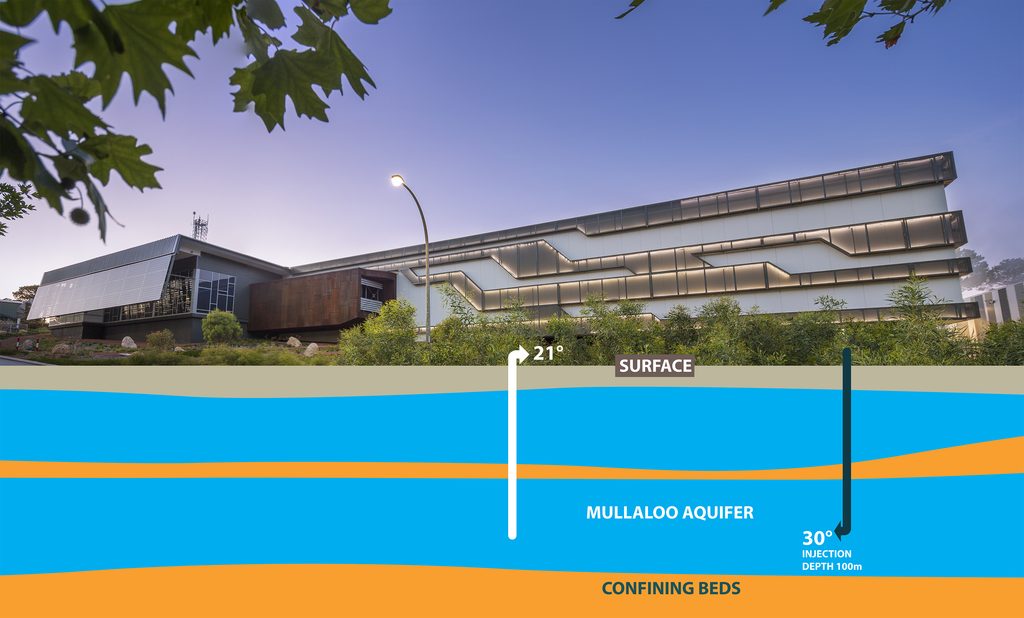
Image source: groundwater cooling at Pawsey
How much water does a data centre use?
There is no single daily figure that applies to all data centres.
Water use depends on the facility, the computing load, the cooling system, the weather, the source of water and what the operator includes in the measurement.
One common metric is water usage effectiveness, or WUE. It usually expresses water use in litres per kilowatt-hour of IT energy.
For example:
- IT equipment uses 100,000 kWh in a day.
- The assumed water intensity is 1 litre per kWh.
- The reported water use within that boundary would be 100,000 litres.
That is only an example of the calculation. It is not an industry average and should not be treated as a forecast for a particular building.
When reading a data centre water-use claim, ask:
- Is the number measured or estimated?
- Is it an annual average or a peak-day figure?
- Does it include drinking water only, or all water sources?
- Does it measure withdrawals, consumption or both?
- Does it include cooling only, or all site water use?
- Does it include water used to generate electricity?
- Is it for one facility, one campus or a whole company?
Peak demand is especially important. A modest annual average may hide much higher water use on hot days, when cooling demand and pressure on local infrastructure can both increase.
What about water used to generate electricity?
On-site cooling is only part of the picture.
Electricity generation can also use water, depending on how and where the electricity is produced. Some power stations use water for their own cooling systems.
This means a facility with low on-site water use may still have an indirect water footprint through the electricity it consumes.
It also means overseas estimates should not be copied into an Australian context without checking the electricity mix, climate, cooling design and reporting boundary.
A strong water assessment should look at both:
- Direct water use on site
- Indirect water use linked to electricity supply
What this means for data centre design in Australia
For proposed data centres in Adelaide or elsewhere in Australia, water demand should be considered early in the design process.
By the time the building layout, plant rooms, roof space, service routes and external infrastructure are fixed, some water-saving options may become harder or more expensive to adopt.
Useful questions for the project team include:
- Cooling method: Will the facility use evaporative cooling, dry cooling, refrigeration, liquid cooling or a combination?
- Peak demand: What happens during hot weather?
- Water source: Will the site use potable mains water, recycled water, groundwater, rainwater or another supply?
- Local capacity: Can the local water network support the proposed demand?
- Treatment: What water quality is required for the cooling equipment?
- Monitoring: Can the operator separate cooling water use from amenities, landscaping and other uses?
- Maintenance: Is there enough access to service pumps, filters, heat exchangers, chillers and treatment equipment?
- Resilience: What happens if a cooling unit, pump, water supply or power source becomes unavailable?
- Reporting: Will the operator publish annual, seasonal and peak-day water-use information?
These questions need input from mechanical engineers, hydraulic consultants, electrical designers, water authorities, sustainability advisers and the building team.
They are also easier to resolve before construction begins.
What building owners should look for in water-use claims
Not all data centre water claims are equally useful.
A credible claim should tell you:
- What type of cooling system is used
- Whether water evaporates as part of normal operation
- Whether the water is potable, recycled or from another source
- Whether the figure is daily, annual, average or peak
- Whether the number is measured or modelled
- Whether indirect water use from electricity is included
- Whether the facility has leak detection and water monitoring
- Whether the operator reports local water impact, not just company-wide totals
Be cautious with broad claims such as:
- “Water efficient”
- “Closed loop”
- “Sustainable cooling”
- “Zero water”
- “Low impact”
- “AI-ready infrastructure”
Those terms may be accurate, but only if the details support them.
For example, “closed loop” may describe the server cooling circuit, while another part of the system still consumes water. “Zero water for cooling” may refer to normal cooling operations, while the site still uses water for other purposes.
The details matter.
Key takeaway
Data centres need cooling because computing equipment produces heat.
Water is often used because it can move and release heat effectively. But water use varies widely depending on the cooling system, the climate, the water source and the facility’s operating conditions.
The most important question is not whether water appears anywhere in the design.
The most important question is:
How much water is consumed, when is it needed, where does it come from, and what alternatives were considered?
For commercial building owners and project teams, water demand should be part of the early design conversation, especially for facilities with high cooling loads.
Mayfair Building Group provides commercial building, maintenance and project management services in Adelaide. For projects involving complex building services, early coordination between builders, designers and service providers can help avoid costly design constraints later in the project.
Commonly asked questions
Read the common questions we get asked below.
Do all data centres need water for cooling?
No. All data centres need heat removal, but not all rely on evaporating water. Some use dry cooling, refrigeration, air cooling or closed-loop liquid cooling systems with very low ongoing cooling-water consumption.
Is liquid cooling the same as water consumption?
No. Liquid cooling describes how heat is collected or transported. Water consumption depends on how the system ultimately rejects heat and whether water leaves the system through evaporation, discharge or other losses.
Can cooling water be reused?
Yes. Many systems recirculate cooling water many times. However, systems with cooling towers still need make-up water to replace evaporation, blowdown, drift and losses.
Can data centres use recycled water?
Yes, where suitable recycled-water supplies are available. The water still has to meet the quality and reliability requirements of the cooling system.
Does AI use water?
AI runs on computing equipment that needs electricity and cooling. The water impact depends on the data centre, the workload, the cooling system, the local climate and the electricity supply. A single litres-per-question figure cannot describe every AI interaction.
What is WUE?
WUE stands for water usage effectiveness. It is a data centre metric that usually expresses water use in litres per kilowatt-hour of IT energy. Always check what the figure includes before comparing one facility with another.
Why does data centre water use matter locally?
Because the impact depends on the source of water, the timing of demand and the capacity of local infrastructure. Annual use is useful, but it does not always show what happens during the hottest or driest periods.